The Role of Public Visual Art in Urban Space Recognition
Published: Jan 1st, 2010
DOI: 10.5772/7120
IntechOpen Downloads
8,577
Total Chapter Downloads on intechopen.com
Anna Januchta-Szostak*
Poznan University of Applied science, Faculty of Architecture, Poland
*Address all correspondence to:
one. Introduction
People in a modern city are like rats in a maze
The E.C. Tolman'south experiments on the behavior of rats in mazes, performed in the 1940s, proved that both man and animals create a tentative, mental map to recognize and larn ecology relationships.
. They need a tool of infinite recognition to go acquainted with the environment they have been forced to alive in. Historically towns owed their uniqueness to deep roots in local tradition. The central market place square constituted the middle of the town. A magic circle of the ramparts and the moat determined a safety and familiar being space, which the inhabitants could hands recognize and flawlessly identify with. It was the legible street network, continued by the nodes of squares, mark out formally of import places, that facilitated the 'wayfinding' (Lynch, 1960) in urban maze. Compact, hierarchical heaven-line of the town, dominated past domes of churches and a town-hall belfry, constituted a characteristic visual code of urban space
The all-time known historical spatial form records are the waterside panoramas of numerous cities institute in the landscape paintings of the 18th century (e.g. the mural of Venice, Verona, London and Warsaw painted by Bernardo Bellotto, Canaletto).
. Since the time of Industrial Revolution, cities used to requite their inhabitants a sense of security and an opportunity of spatial orientation thanks to their pocket-sized size and ordered grid layout within a limited area.
Along with spatial expansion of 19th- and twentyth-century cities, consequent development of their suburbs and mixture of forms, functions and architectural styles, a chaos crept into cities, defined by S. Chermayeff and Ch. Alexander every bit "modern space salad". Modernism, introducing globally unified architectural patterns and inhuman calibration urban structures, rejecting traditional harmony and hierarchy, contributed to the sense of disaffection and breach in a big city. Simultaneously though, the same modernistic trends started off the revolution in visual arts. Artists' abandoning lounges for the sake of the streets, freedom of creative voice and expression of form, inspired a number of research on the processes of artwork perception likewise as its social and even political function in the public infinite (Kwon, 2002).
The newspaper deals with the theories on urban infinite recognition and the role of public art in raising the 'imageability' of urban enclosures as well every bit their cultural quality and social attractiveness. The writer presents the methodology of visual art location in urban public places on example of Poznan urban center.
Advertizing
two. Urban space recognition
The basis-breaking Edward Chace Tolman's discovery of the process of constructing and accumulating spatial knowledge, casted a new low-cal on the perception of urban space and laid a groundwork for mental maps construction as a tool of urban structure recognition. The mental mapping method also immune to discover what kind of attention people paid to particular places and what function artworks played in recognition and identification of urban space.
two.i. Perception of physical infinite and urban structure recognition
Visual space perception is a psychological cerebral process consisting in mental copying objects and events of the outer world in relation to the processes which have place in human body. The process of perception was a field of study of interest for researchers in a variety of fields: psychology (Gibson, 1950; Tomaszewski, 1986; Bańka, 1999), particularly behavioural and environmental psychology represented by H.Thou. Proshansky, T. O'Hanlon, Due west.H. Ittelson, L.G. Rivlin. (1977) and others, who analysed the use of behavioural maps; anthropology and sociology (Hall, 1966; Sommer, 1967; Lawson, 2001) as well as geography (Forest, 1992), urban environs research and boondocks planning, adult by K. Lynch (1960), O. Simonds (1961), Thou. Cullen (1961), D. Appeleyard & J.R. Meyer (1964), Ch. Alexander (1977), A. Rapoport (1977), N.L. Prak (1977), Y.F. Tuan (1977), Ch. Norberg-Schulz (1971) and many others. Some of the fields of research involvement were as well the visual perception of fine art (Arnheim, 1954; Miles et al. 1989) and media in urban space (McLuhan, 1964; McCullough, 2004). The Gestalttheory
The theory initiated by the Berlin School at the starting time of 20th c. (High german: Gestalt - "class" or "whole") explaining that "The whole is greater than the sum of the parts".
has given rise to the holistic perception of the infinite concept which consists in perceiving visual components every bit organized patterns or wholes, instead of many different parts.
Mental identification is the link between space perception and amalgam spatial knowledge. The main accomplishment has been the discovery of the cognitive scheme which controls the processes of perception, recognition and memorisation of physical space. Every bit a result of these processes, a human listen creates an image of the space chosen a cerebral map, making it possible to transform and interpret the information. The choice and interpretation of the perceived information is performed by cultural and personal filters (Rapoport, 1977) and referred to established cultural patterns (Alexander et al, 1977).
Along with examining the perception processes, scientists analysed a spatial code of the city and urban structure arrangement which determine orientation and identification of the space. Many of Polish urban and landscape planners, such as J. Bogdanowski, Due west. Czarnecki or 1000. Wejchert conducted inquiry on urban infinite perception as well as townscape and landscape limerick, still, their achievements went unnoticed due to the Atomic number 26 Curtain. Already in 1950s Władysław Czarnecki analysed the factors influencing landscape composition, which were too seen from the bespeak of an observer in motion e.g. optical illusion, colour, foreground and groundwork, dominants, rhythm, contrast, frames of vantage points, leading lines, dividing and closing surfaces, nodal points, solids, etc. His observations seem to be like to later Lynch's conclusions (Böhm, 2004, pp. 41).
Kevin Lynch in his famous book The Image of the City,published in 1960,introduced the mental mapterm into town planning every bit a method of spatial code notation and recognition. Lynch proves that users perceive and organize spatial information in consistent and predictable ways, creating their own mental maps with five elements: paths; edges, districts, nodes and landmarks. The v elements determining urban space organization, have made an of import contribution to the development of theories and methods of composing elements of urban structure in the fashion which is compatible with human psyche needs. The elements also appear in works past numerous European researchers e.g. Thousand. Trieb
M. Trieb enumerated: roads, borders, central points and management marks (Stadtgestaltung, Teorie und Praxis, 1970)
(1970), J. Castex & P. Pannerai
J. Castex & P. Pannerai singled out: roads/paths, barriers, nodes, zones and landmarks (Notes sur le construction de l'espace urbain, 1971).
(1971), G. Wejchert
K. Wejchert selected similar elements of urban composition: streets, regions, edge strips, dominants, outstanding elements of landscape, nodal points and distinguishing marks (Elements of Urban Composition, 1984)
(1984) amid others.Paths and landmarks seem to be specially useful in the 'wayfinding'
K. Lynch defined wayfinding equally "a consistent use and organisation of definite sensory cues from the external environment" (The Epitome of the Metropolis, 1960).
for they serve as important direction lines and reference points in navigation through the urban center. Series of views, perceived by an observer in motion, create a concatenation of mental images. Cullen'due south notations of 'series visions' and McLuhan'southward 'sequences of the visual space' led to the conclusion that perception is a dynamic process. This thought has been developed in The View from the Roadby D. Appeleyard, 1000. Lynch & J.R. Meyer (1964), who observed that the speed of receiving visual stimuli by an observer has a crucial influence on urban space perception and recognition
These discoveries have initiated landscape studies on transportation routes and the research on moving observers' perception. They too influenced the diversity of spatial organization of pedestrian zones and transportation corridors (Appleyard et al, 1981).
. Chiliad. Wejchert (1984) introduced a record of visual sequences in the form of a graph of the recipient's emotions, so called "curve of impressions".
In 1970s Michael Trieb proposed a symbolic code of sequential note of urban programme including privileged location in space, closure, limitation of motion, spatial domination, narrowing as well as context continuation. He also emphasised the role of art and "street piece of furniture" in spatial organisation of public spaces. Trieb's sequential notation was adult in 1998 past East. Cichy-Pazder, who suggested an enriched typology of determiners of perceptive identification (nodes, axis, partitions and dominant signs).
2.3. Between the image of enclosure and the identity of the identify
Enclosure, urban and landscape interior, "outdoor room"(Cullen) as well as "positive outdoor space" (Alexander) – all those terms, relating to the space perception, mean a limited landscape unit, congenital of walls, floor, ceiling (ordinarily heaven) and elements of landscape "furniture". Aleksander Böhm emphasises the meaning of the term enclosure, which gives space the condition of a identify. Without the enclosure,space loses its sense.
Goodall, B. (1987), Dictionary of Human Geography, Penguin Books, London, p. 152, cited in: Böhm, A. (2004). „Wnętrze" due west kompozycji krajobrazu
The idea of enclosure, derived from landscape design (Hubbard & Kimball, 1917; Kepes, 1944) and developed by Gordon Cullen (1961) and Yoshinobu Ashihara (1962), seems to be fundamental for visual art perception in the context of a particular place. Morphological paradigm of a city results from the relation between the positive space (P-space), of determined shape, and the negative infinite (N-space) - formless emptiness. The spatial relations between a form and its surroundings were simultaneously explored by Y. Ashihara (1962) and J. Żórawski (1962), and deepened by Engel & Jagals (1970/1071), J. Tanghe (1976), Ch. Alexander (1977), R. Trancik (1986), J.Fifty. Motloch (1991), S. Bong (1993) and many others. P. Peters (1973) pointed out that a city structure is based on "cells", determining its space identity, and the perception of the infinite of streets and squares results from human kinaesthetic abilities. According to Yi-Fu Tuan (1977) 'existence in a place' is continued with the demand of identification, while experiencing the space requires move from one place to another.
Yard. Wejchert has developed the theory of urban enclosures, as the bones structural units of the town. In the early 1950s, on the basis of small-scale urban settlements assay, he singled out 'multi-fractional enclosures' (main and added), 'overlapping' and 'centripetal' equally well as illustrated examples of using 'leading' and 'closing' lines and surfaces, emphasising observation angle, proportions of enclosures and openings. Many of the phrases included in the early works by K. Wejchert, coincide with much later schemes past Motloch (Böhm, 2004, p. 38).
John Fifty. Motloch (1991) expanded on the theory of identify and continued studies on examining spatial relations of the course (piece of furniture, sculptures, buildings) and the groundwork (landscape and urban walls). He claimed that a city development, from the space perception, point of view should lead to the intensification of the place sense, its clarity and distinctiveness of course and meaning.
J.O. Simonds (1961) remarked that the lack of the sense of interior causes discomfort. He paid attending to feelings (excitement, curiosity, limitation, concentration, relaxation etc.) as well equally the possibility of controlling and sequencing the views of various landscape enclosures. (Simonds, 1998).
The studies by K. Lynch' full-bodied on the identity and structure of city images. He divers 'imageability' as "that quality in a concrete object which gives it a high probability of evoking a strong prototype in any given observer. It is shape, color, or arrangement which facilitate making of vividly identified, powerfully structured, highly useful mental images of the environment. It might too be called legibility, or perhaps visibilityin a heightened sense."(Lynch, 1960, p.9).
The behaviouristic psychology research reveals that the attributes of space which are recognised by observers concerning continuity, coherence and uniqueness enable people to identify a place (Bosky et al., 1987). Subsequently obtaining comprehensive information about the place, it is not anonymous any longer to the observers (Bańka, 1999), which is non, however, identical with identifying with the place. Co-ordinate to Ch. Norbert-Schulz "being in a place" means something more than localisation but results from identification with the place past feeling its character, which tin can exist "natural", "human being", or "spiritual". The phenomenological experience of the character of environment, regarded as genius loci,combines simultaneous perception of visual structure of enclosure with identification of its cultural and symbolic meaning. "Every place which has special meaning is actually a eye" (Norbert-Schulz, 1999, pp. 224). Centre is a specific reference point of existence space. Centrality is then an indispensable feature of sacral space which emerges from surrounding chaos and creates a sense of innerness (Mamford, 1961). The meanings of space, place and site (Rendell, 2006) for a contemporaryflâneur
The effigy of flâneur (city observer) created by Ch. Baudelaire, was adopted and analysed past Walter Benjamin in Passagen-Werk (1921-1940)
,wandering around a maze of the urban center, have been often studied in the context of new media evolution.
two.4. From mental maps to hypermedia maps
Mental maps, which are used in various fields of psychology, instruction and management, take also been applied in urban and landscape planning as well as architecture and visual arts. Lynch and Appleyars were pioneers in mental mapping studies. Comparing sketches, made by non-professionals, was initially aimed at research on how individuals perceive and navigate through the urban landscape. However, since 1970s this method has been frequently applied to community collaboration in town planning. "The idea that local inhabitants need to stir into the planning process the paradigm they have of places – their personal images – has become standard practice in city planning. A well-known example involved Randy Hester and the town of Manteo, North Carolina. In 1980 […] using a variety of imaging techniques, Hester uncovered a 'sacred structure' of the residents' downtown and fabricated a map of it as a guide for evolution."
D. Wood: http://www.techkwondo.com/obj/pdpal_msg/PDPal_Denis_Wood.pdf
The growing influence of net on social, economic and cultural relations has been observed for the last ten years
Since 1988 Internet has been made available to the commercial utilize, however, just ten years ago, it became a pop advice tool.
. Both exploring a city and social life of their inhabitants take place by means of digital technologies. New communication technologies alter the perception of urban space as well as its utilise (McCullough, 2004), which causes the devaluation of urban public spaces significance as the areas of social integration. In an ironic, only unfortunately possible, vision of generic city – de-humanised, standard, identity-devoid one - Rem Koolhaas raises the question of the role of traditional public spaces in lives of local communities. Along with the disappearance of social functions, city infinite becomes devoid of basic diversification factors and, consequently, of its identity (Bonenberg, 2009). Common multimedia civilisation, dominating over using books or individual perception of objects and phenomena, leads to the state of affairs that in order to interest or even make people come to a particular place, information technology needs to exist advertised on the Cyberspace beforehand (Siewczyński, 2009).
However, the potential of experimental Information technology supported programs gives also a take a chance of "reconstruction of identity" of public places as well as creation of new tools for their recognition and navigation. A popular thought based on infinite identification process is collaborative mapping. At that place are many types of collaborative maps (Google Maps, Wiki Maps etc.) which vary in their target use, subject matter and kinds of users. Ane of them is a popular Open up Street Map (Wikipedia) working in collaboration with GPS organisation. Private users can enter new data items into the existing Cyberspace maps concerning historical urban development and significant cultural events, famous ancient monuments, spectacular contemporary buildings and artworks, shopping centres etc, as well as traffic intensity indicators (Bonenberg, 2009). The recent results in the field of digital techniques enable u.s.a. not only to describe simply besides visually model the urban infinite through hypermedia functions.
One of the most difficult challenges is collecting and storing digital information in the place where they come into existence likewise as creating an opportunity to use multimedia information on the urban center in the real space. It is possible thanks to Dataspace
The term coined by prof. T. Imielinski, Department of Informatics Rutgers University, USA
system formulated by Tomasz Imieliński, a pioneer in the field of mobile data, who described the concept as "concrete space supplemented with digital data". Both virtual data accessibility in physical urban space and creating digital visualisations, based on existent urban structure perception, contribute to better identification of the city also equally identifying with the metropolis. Interactive virtual games taking place in the urban reality are an effort to concenter teenagers to learning about and co-creating the epitome of their city.
The urban space recognition and mental mapping based on hypermedia may be meant both for action (specially useful for travellers) and for knowledge, equally they combine infinite and mental organisation by relating maps and projects to the images of urban areas, and documents on social history - to their cultural background (Gallet-Blanchard & Martinet, 2002). The data is available through interface elements such every bit windows, animations, texts referring to urban spaces also as interchangeable pictures representing historical and gimmicky maps or photos taken by users. The social participation in the cosmos of hypermedia maps is achieved past interactivity of form and contents in these media. Hypermedia programs on urban history like the CD-ROM Georgian Cities (Gallet-Blanchard & Martinet, 2002) or Kyoto Virtual Time-Space
The research programme is conducted at the Ritsumeikan University past interdiscyplinary teem Kyoto Art Entertainment Innovation Enquiry within the framework of the 21st Century COE (Center of Excellence) Research Program.
can be used both for information and educational purposes too as city promotion. Such programs are being deployed also in Smooth cities: Wrocław, Kraków and Poznań.
Contemporary hypermedia are a tool of meta-perception. The cyberspace itself, though, constitutes a new virtual maze which requires new tools of recognition.
Advert
three. Visual art in public space
three.1. The definition of public visual art in the 20th century
Visual art is an artwork that appeals primarily to the visual sense and typically exists in permanent form, such every bit traditional plastic art (drawing, painting, sculpture, printmaking) and modernistic visual fine art like photography, video, filmmaking, reckoner art etc.) too as architecture, design and crafts. The term public fine art (Taborska, 1996; Goldstein, 2005; Finkelpearl, 2000) refers actually to works of art in whatever media that accept been designed and performed with the specific intention of being sited or staged in physical public domain, unremarkably external and attainable to all.
http://en.wikipedia.org/wiki/Public_art
Since the aboriginal times monuments and memorials have been present in public spaces, emphasising the centrality of important sacral and secular places. However, the public sculptures primarily served representative and propagating goals. The notion 'public art', as an alternative to aristocracy gallery fine art, emerged in 1960s, and its aim was to revitalise urban infinite. Gradually, the most characteristic feature of public art became an opportunity to express current problems and to communicate with its exposition places (Miles, 1997; Kwon 2002; Rendell, 2006) and its recipients (Lacy, 1995). The example of the Pompidou Centre in Paris (designed by R. Pianoforte, R. Rogers and P. Rice, and constructed from 1971 to 1977), which is a masterpiece itself, proves that both permanent and temporary artworks, like happenings, installations and even street theatres, contribute to the place identity creation. The Street Art, which arose from a need of free artistic expression on the public forum, although not everywhere socially accustomed, is also a fabric of building the image of a place(Schwartzman, 1985). 'Street artists' attempt to have their piece of work communicate with common people nigh socially relevant themes without being imprisoned by aesthetic values.
Determining the role of public art requires considering fashions and trends which have influenced it throughout diverse periods. In the 1970s and 1980s public art intersected with functioning art, conceptual art, installation art, land fine art, process art, community-based art, and site-specific art. Thus, some art interpretations, sometimes quite remote from the Kantian idea of universally recognised beauty, take appeared, such equally Suzane Lacey's 'new genre public art'
Lacy, South. (1995). Mapping the Terrain: New Genre Public Art. Bay Press, Seattle.
, which emphasises its social engagement and collaboration. On the mail-modern metropolitan urban scene, new elements constantly sally, challenge the status of public art, like: urban furniture, lighting, multimedia, graffiti and even commercial art.
3.2. Architecture and art equally spatial landmarks
This and the following paragraphs are partially based on author's previous publication: Januchta-Szostak A. (2007). Methodology of Visual Fine art Localization in Public Spaces on Example of Poznan City
In the 20th century, the time of unification of mass building and cultural patterns, art in the public domain took on a very responsible function of creating the important spatial tags and building identity of the place. Art always stands in opposition to standardization
Prof. Włodzimierz Dreszer said that "art is anti-thesis of standard" in: Dreszer Westward. (2007) Przestrzenie wyróżnione krajobrazu kulturowego, (in:) Sztuka projektowania krajobrazu, pp. fifteen-19
. The inimitable form of public art, situated in the context of unified architecture, constitutes a focal betoken. Just isn't architecture a work of art likewise? From the indicate of view of many artists, architecture forms but frames, background or pedestal for a unique works of art. Even so, in the city scale, the sculptural forms of compages take a deserved elevation position in creating dominant landmarks in townscapes, sometimes fifty-fifty regardless of the urban context. Thus, the relevant respond to the higher up question depends on cultural pregnant, aesthetical quality and uniqueness of the object.
The 20th and 21st centuries abound in spectacular examples of architectural icons which take get not simply the reference points, but also the aim of cultural tourism (Pearson, 2006), such equally artworks by Frank O. Gehry (e.chiliad.: Guggenheim Museum, Bilbao), Daniel Libeskind (the Jewish Museum in Berlin), Peter Eisenman (e.g.: Memorial to the Murdered Jews in Europe, Berlin), Santiago Calatrava (e.m. The City of Art and Science, Valencia), Renzo Piano (e.g.: New Metropolis in Amsterdam, Cultural Eye in Noumea-New Caledonia), Bernard Tschumi (due east.thou. Park de la Villette, Paris), Enric Miralles (eastward.g. Iqualada Cementary, Barcelona) and many others. Jane Rendell, in her recent book Fine art and Compages: a Infinite Between, analyses significant works created by both artists and architects that seek to blur traditional boundaries between the fields.
Many artists claim that it is the lack of function which differs compages from fine art. Rendell takes issue with that opinion, proverb that "art is functional in providing certain kinds of tools for cocky-reflection, critical thinking and social change"(Rendell, 2006, pp.3-4). Moreover, there is also architecture without whatsoever utilitarian functions – Folly, which is merely a decorative accent. Its contemporary example is the Park de la Villette, where Bernard Tschumi in 1982 constructed thirty-v architectural follies.
Since art has abandoned galleries, information technology may have gained a range of influence and expression which is comparable to architectural one. An open up outdoor space gives the artists freedom of large works creation incorporating even natural surround (east.g. Richard Long, Robert Smithson, Anthony Gormley, Andy Goldsworthy et al.). Permanent works of art integrated with architecture and landscape blueprint were sometimes included in urban development program like in the case of the new city of Milton Keyens in England, designated as a new boondocks at the cease of 1960s.
The process of shaping the townscape happens on every level of perception: from panorama, dominated by land forms or high-rise objects; through architectural and sculpture compositions organizing space of squares and streets; to homo-size sculptures familiar to pedestrians or even urban details. Regardless of its size, the characteristic feature of any artwork is its unique class which makes it stand out from the surround. Some forms of visual art are ascendant, others institute only accents in urban enclosure, some bear historical or cultural message, others provoke or intrigue past modern form, raising admiration or consternation, however, they exercise individualize the urban infinite, becoming of import spatial tags facilitating orientation and navigation as well as anchor-points on mental maps of the inhabitants and tourists.
3.3. Cultural meaning of fine art and mental anchor-points
Chritian Norberg-Schultz (1999, p.223) remarks that the purpose of a piece of art is to retain and convey existential meanings while a man, through perception and understanding the symbol, exposes themselves to an human activity of identification which consequently gives some significant to their individual existence. He also emphasizes that the meaning revealed by art in a particular place also determines the character of the place.
The unique works of famous architects and artists tin now exist constitute in every part of the global village. However, not all of them are able to feel genius loci and transform it into art language without losing historical continuity as well as cultural and spatial coherence. Some of spectacular objects, such equally Richard Serra'south Tilted Arc
Richard Serra's massive, wall-like steel sculpture was removed from Federal Plaza, New York, in 1989.
, take never get 'anchor-points' for the local communities. In the Hague, municipal authorities fabricated a cracking deal of endeavour to supercede the pulled downwards churches with architectural and sculptural landmarks in order to construct a mod network of ballast-points. The difference between visual landmark and commonage anchor-signal lies in mental acceptance and social identification with the artwork. Sometimes inconspicuous sculptures and fountains get city symbols, eastward.g. Neptune in Gdansk, Poznan's famous goats symbol, Mermaid in Copenhagen and Warsaw, or Mannekin Pis in Brussels. This famous statue of a piddling boy is a perfect representative of the irreverent sense of humour and the unique Brussels' icon.
Unlike permanent artworks, temporary open air sculpture exhibitions and artistic happenings are transient phenomena, which exercise not seem to exist regarded as permanent points of mental references. However, such short-time but repeatable and intensive events can contribute to building the cultural image and identity of their location places. For example, Pompidou Centre in Paris, or Malta Lake in Poznan are unremarkably associated with cultural events.
The significance of commemorative art, highlighted by many authors (Crinson, 2005), provides the urban space with the historical continuity and integrates local communities. Sculptural architecture of some monuments and memorials, such as the Jewish Museum by D. Libeskind and the Memorial to the Murdered Jews in Europe by P. Eisenman, both located in Berlin – one time Nazism'southward upper-case letter, establish a worldwide symbol of collective retentiveness. Their expressive grade and size is as total as Holocaust and shredded similar its victims' individual tragedies. The spatial arrangement of the memorials allows gathering and breach at the same time.
Collective participation in commemoration events builds the feeling of integration based on cultural membership, historical consciousness and social bonds resulting from mutual moral values. In the post-communist countries like Poland, though, an mental attitude towards commemorative monuments is clashing due to the political changes. The decisive historical transformation of ideology resulted in demonstrations and pulling downwards monuments, which was a kind of commonage manifesto also integrating its participants.
The effect of social integration tin exist accomplished via public art by different means: i) collective participation in commemoration events; two) spatial organization of interactive artworks, which encourages interpersonal relations; 3) social date and collaboration on cultural projects.
3.4. From 'site-specific' fine art to community engagement
The 'site-specific' art is one of many trends ready in the second half of the 20th century, notwithstanding, it has special significance for urban space recognition and spatial organisation of public places as it deals with urban context. About of contemporary architects, landscape architects and urban designers attach a lot of importance to architectural context mapping, while artists emphasise the individual expression, autonomy and universality of art.
The fine art of architecture is ever 'site-specific', even though some creators, like Rem Koolhaas
Refering to Rem Koolhaas' s slogan: "Fuck the Context"!, in: Koolhaas, R. & Mau, B. (1995) S,Thousand,L,40. Monacelli Press, pp. 495-516, New York
, preach the provocative commendation of individualism and independence of the artwork from its context. This way or another, context exists and - the basic questions constantly arise: has the intangible spirit of art profound implications for place-making or should the artists mind carefully to genius loci?
Miwon Kwon (2002) describes the unstable relationship between location and identity every bit well as controversies around 'site-specific' artworks created by John Ahearn, Richard Serra, and others. It is worth mentioning that in 1970s and 1980s site-specific approaches to public art were promoted and registered within the guidelines of national and state organizations in the United states of america
"[…] even though site-specific modes of artistic exercise emerged in the late mid 1960s – roughly coinciding with the inception of the Art-in-Architecture Programme of the General Services Administration (GSA) in 1963, the Art-in-Public Places Program of the National Endowment for the Arts (NEA) in 1967, and numerous local and state Percentage for Art programs throughout the 1960s – it was not until 1974 that concern to promote site-specific approaches to public art" Kwon, Chiliad. (2002), pp. 56-63.
. The 'design team directive' in the US encouraged artists to share responsibilities with architects and urban planners in deciding about spatial arrangement of public spaces. Similar deportment have been undertaken in Europe, particularly in the Uk, aiming at cosmos of 'amenity planning guidance' as well every bit methodology and framework for cultural mapping and planning (Evans, 2008). During the 1980s local regime an commercial companies in the Great britain began to appreciate the value of art in shopping and business concern development. At the beginning of 21st century landmark sculptures appeared to be also a tourist attraction (Pearson, 2006). Considering growing popularity of cultural tourism, it is quite believable that the next step in the evolution of 'site-specific' art will be 'tourist-specific' art.
An ecological tendency within 'site-specific' art is as well worth mentioning, though it is certainly a subject for a dissever publication. Represented past a German language creative person, Herbert Dreiseitl, information technology involves creating sculpture and water compositions, introducing rainwater retentiveness, infiltration and recirculation (e.g. Potsdamer Platz in Berlin; Tanner Springs Park in Portland, U.s.a.). The variety of water forms and their psychological interactions are also crucial for raising the quality of urban space both in aesthetic and symbolic aspects (Dreiseitl et al., 2001).
In 1993 Suzanne Lacy initiated the plan "Civilisation in Activeness: New Public Art in Chicago". The new approach, that broke with previous models of 'site-specificity', was described by Ch. Sperandio every bit 'community-specific', and past Thou.J. Jacob as both 'result-specific' and 'audition-specific' art. It has changed the pregnant of public fine art from the fine art-in-public-places into the real public-art focused on freedom of expression and agile participation of citizens in the artworks cosmos. Many artists acting at the intersection of art and cultural activism, such every bit Helen and Newton Harrison, Suzanne Lacy, Stephen Willats, accept been developing new forms of creative dialogue with various audiences. For the 'new genre public art', aesthetical form was only a medium of socially and politically relevant content.
three.five. Multimedia and new media in urban culture
The common relations between the perception of metropolis and the evolution of media have been ofttimes studied
The subject have been studied by such authos as: McLuhan, 1964; Jenks, 1995; Burgin, 1996; Gallet-Blanchard & Martinet, 2002; McCullough, 2004, Tribe & Jana, 2006 and many others.
, under the influence of philosophers such as Georg Simmel or Walter Benjamin (Gallet-Blanchard & Martinet, 2002). There are ii main aspects emerging from this line of research: 1) significance and expression of multimedia and new media fine art in the physical urban infinite, and 2) perception and popularization of public works of art in the cyberspace.
In the light of 'new genre public art', mass every bit new media are a perfect tool of communication with the general public. Withal, some kinds of 'audition –specific' fine art were considered as the art of space unification. Large-size billboards and video installations were often deprived of the proper name of art equally they conveyed the same contents regardless of their localization. Most of west European cities have already solved the problem with billboards located in historical downtowns. In Polish cities, though, there is withal an ongoing entrada on exposition area between architecture and sculpture on the 1 manus and different forms of commercial, advert fine art on the other.
Since the video art was born in 1970s it has been exploring alternative strategies of adopting existing urban forms as sites of artistic intervention. The artworks by pioneers of video installation, such as Nam June Paik, Gary Loma, Tony Oursler, Sam Taylor-Wood, seemed to exist as controversial as Marcel Duchamp'due south provocative "Fountain", or Cambell's "Soup can".
However, a remarkable progress in digital technology allowed to create big-size, interactive video sculptures, like the Crown Fountain (design by Jaume Plensa, 2004) located in Millenium Park, in Chicago. The fountain is composed of two 15.2 one thousand alpine, cubicoid, towers covered with light-emitting-diodes (LEDs) and a black granite reflecting puddle placed between them. From time to time the giant LED-screens brandish enlarged faces of anonymous citizens of Chicago. The Crown Fountain, however controversial in size, is an excellent example of 'community-specific' and socially integrating piece of fine art. Information technology was praised for its entertainment and artistic features also as highly accessible spatial organization of a common gathering identify allowing physical interaction between the public, media and the water.
At the kickoff of 21st century IT specialists and artists noticed an immense creative potential of digital technologies and estimator- aided blueprint programs (McCullough, 2004) as well as common accessibility of hyper media. Internet became a new public space for artworks creation, exposition and discussion. The spatial consequence of the approach to creation procedure and its results is breaking with the monopoly of museums and art galleries equally the exclusive places of interacting with art. New Media Art (Tribe & Jana, 2006), as an artistic trend, suggests uniting computer graphics with animation, interactive technologies, calculator robotics likewise as biotechnology in order to gain new quality in art. The results of work of such artists every bit Wolf Vostell, John Maeda, Eduardo Kac, show directions of artistic development by means of new media (Bonenberg, 2009).
Advertisement
iv. Methodology of locating visual art objects in public domain on example of Poznan city
The subject of research conveyed past the author in Poznan was the quality of public areas and possibilities of making them more than attractive by introducing monuments and h2o elements. The activities of municipal authorities consist simply in looking for a decent location for the piece of fine art. The lack of cultural planning guidance fabricated the author search for the art-location methodology enabling not just to improve the visual quality of public places but too to raise the recognisability and 'imagebility' of the city.
One of the outset research tasks was creating typology of objects and defining their role in functional and spatial structure of the city. The parallel task was connected with finding the master areas for metropolis image creation. At that place are 3 questions oft arising, which the research was supposed to reply:
Which public places are the most important and suitable ones for visual art location?
How to adjust those areas to raise the significance, artful and functional values as well every bit social attractiveness of the public places?
What can be the role of visual art forms in different types of urban space?
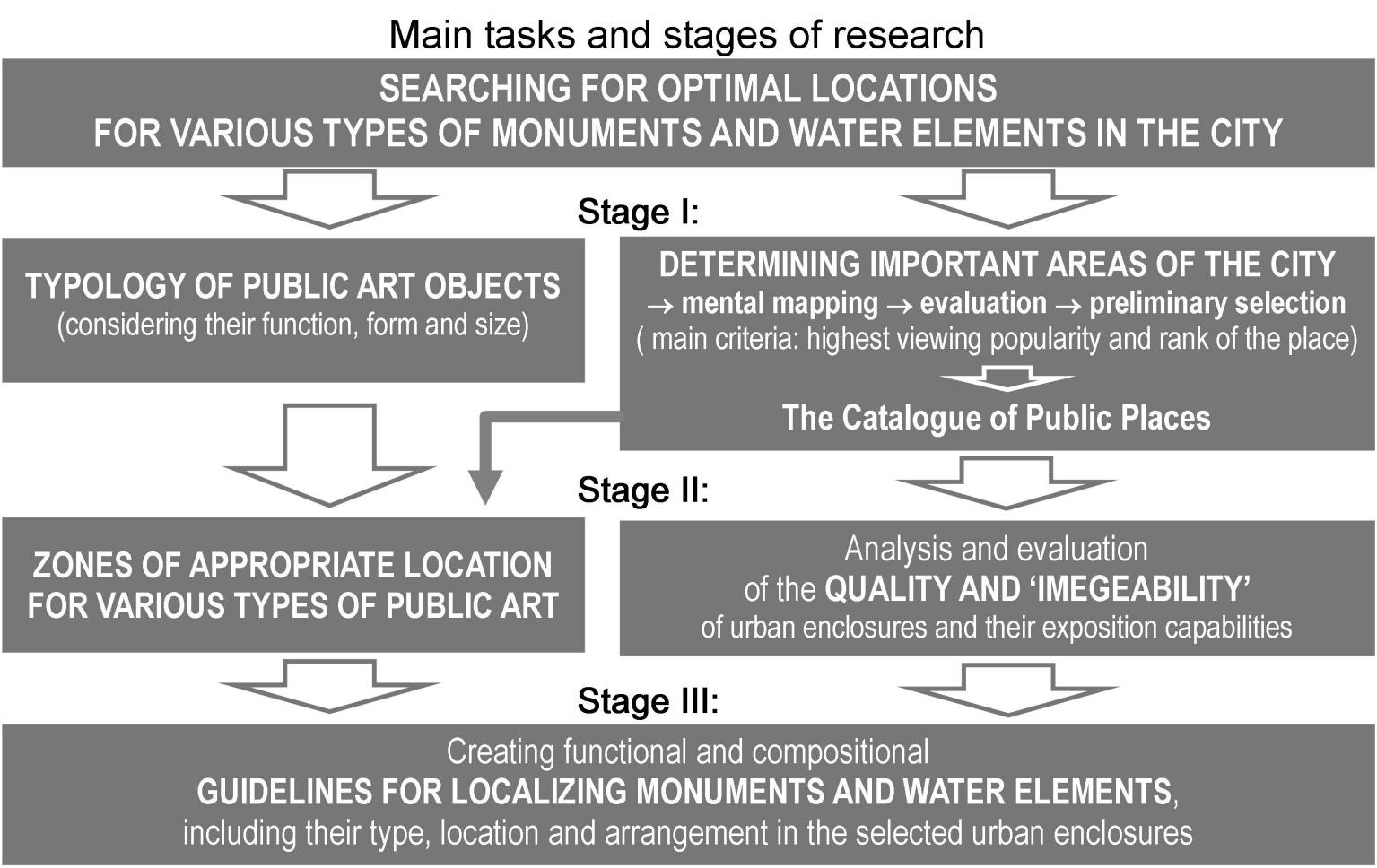
The process of searching for optimal locations for various types of sculptures as well equally spatial arrangement of "outdoor rooms", was divided into three stages, presented by the scheme (Fig.ane)
Advertizing
5. The typology of sculpture and h2o elements as urban details
The typology of public fine art, from the perspective of artistic limerick, is considerably wider than the one presented below. However, for the purpose of the inquiry on the public
Figure 1.
The analysis of possibilities of visual art location in public domain of Poznan city – main tasks and stages of inquiry
places quality improvement, conveyed by the author in Poznan, several unlike types of sculptures and water objects were singled out. They differ in manner of placing, compositional values, function, size and their social role. That typology is a kind of pigeonholing, which many of artists would rather avoid, but information technology seems to be important for creating the planning guidelines for cultural mapping.
Advertisement
half dozen. The stages of the inquiry
half dozen.1. Stage I: the assay and evaluation of functional and spatial structure of the city with respect to possibilities of locating monuments and water elements
As the public works of art engage in a dialogue with the customs and the place, the 2 main criteria: 'viewing popularity' and 'rank of the place', appeared to be crucial for determining zones of their location. Initially, the entire expanse of the urban center was subjected to the analysis, in social club to define the most important public places of the city. Because of high concentration of pedestrian zones and location of the master areas of metropolis image creation, the analysis was subsequently narrowed to the downtown.
The 'infinite recognition map' was created on the basis of mental mapping method. Students of architecture and citizens of Poznan were asked to select the well-nigh ofttimes visited places likewise as the near important ones (in their opinion). Every bit a result, over 120 public places were indicated in the downtown area and later subjected to preliminary selection. The evaluation of public places in accordance with the accustomed criteria, was conducted with the utilize of graphic and statistic methods. The main and sub-criteria, prepared for Poznan city and listed in Table 3, reflect detail aspects of the analysis.
Table 1.
Determination of type of object
A. Object placing
Direction: directed at ane side, 2 sides, multi-side/in the circular
limerick, decoration, used for foreground or background exposition
symbolic
serving active or passive entertainment,
integrating, disintegrating/ separating (moat)
water retentiveness and infiltration
ecological
climatic
utilitarian (e.grand. water source, )
E. Size of the object
Estimated size of vertical dimension in comparison to human size
The ratio of acme of the object to the height of urban walls
Estimated size of horizontal dimension
XL
over half dozen m
VXL
1: ane and over
HXL
over 50% of the floor size
L
4 ÷ 6 m
VL
1: 1,5 i: ii
HL
31 50%
M
ii iv thou
VM
1: 2 i: 4
HM
11 xxx%
S
ane 2 chiliad
VS
one: 5 1: 9
HS
1 10%
XS
upward to ane thousand
VXS
less than 1: 10
HXS
less than 1%
Tabular array ane.
Typology of sculpture and water elements
Table 2.
The employ of typology of sculpture an water elements on examples of existing objects
Basic criteria
Sub - criteria
Elements of functional-spatial structure of the city
Ratio of importance
Viewing popularity
Connection with main transportation routs
i.one. vehicles (transportation arteries, principal and collective streets)
O1.1. = 1
i.two. public send- railroad train, motorcoach and tram stations
O1.2 = i,2
1.3. pedestrians ( main streets, shopping routes)
O1.3 = 1,5
1.4. important cycling paths
O1.4 = 1
1.5. h2o means
O1.v = 0,7
Connection with primary tourist routes
2.i. The Royal-Regal Track
O2.1 = 1
2.ii. Piastowski Route
O2.2 = 0.5
Master areas of services concentration
3.i. the metropolis eye
O3.1 = ane
3.ii. centers of districts and chief shopping streets
O3.2 = 1
3.3. PIF, university campuses
O3.3 = i
Rank of the place
The zone of historical evolution
one. the core of the city
R one.1 = 2
ii. 19th century districts
R 1.2 = 1
3. remaining areas (20th century)
R 1.3 = 0,5
Main areas of the city image cosmos
1. the axis of the urban center (The Royal-Imperial Rails and its zone of influence)
R 2.1 = 1,5
two. the urban center "gates" (Central Station-PIF, river harbor-historical center, Malta-sport center, airport)
R 2.2 = 1,two
3. the metropolis'due south "lounge" – representative streets
R 2.3 = 1
Quality of urban space
1. zones of historical structures under law protection
R 3.1 = one
2. high concentration of antique buildings
R 3.2 = 1
3. areas of exceptional landscape values
R 3.3 = ane
Neighborhood of public cultural and administration institutions
1 of international, national and regional importance
R iv.i = 1,ii
2. of city importance
R 4.ii = 1
3. of district importance
R four.three = 0,7
Table three.
Multi-criterion analysis for Poznan city
Figure 13.
Poznan - areas of the highest viewing popularity – synthesis
Figure 14.
Poznan - areas of the highest rank of the place – synthesis
Later on evaluation and preliminary selection, 60 public places (streets, squares, parks, river banks etc.), located in the zones of the highest importance, were described in "The Catalogue of Public Places in Poznan". Information almost all individual public places included the description of their location, neighbourhood, spatial layout and function, short SWOT assay also as the preliminary estimation of their capabilities for locating monuments and water elements. All the public places were evaluated in accordance with the criteria multiplied by the ratio of importance to objectify the decision-taking procedure.
Mental maps have shown formal and breezy paths and nodes, which people value well-nigh. The comparison of the areas with the results of unbiased analysis of expositional potential of the downtown made it possible not only to decide the best location sites for artworks, simply also for 'wounded spaces' whose expositional potential has non been used due to the lack of determination apropos their final spatial shape. These areas of loftier importance, frequently situated in the very center of the city, although establish the key elements of urban structure too as nodal points of the main tourist routes, have remained neglected and couldn't be taken into consideration because of depression visual qualities. From the social bespeak of view, information technology was interesting to compare the above schemes (Fig. 13 and Fig. 14) with a map of crisis facts occurrence (e.k. loftier charge per unit of unemployment, poverty, malversation, among others), which are commonly observed in the downtown area. The comparison showed that some of the areas which are not eagerly visited and socially degraded are still mentally important and constitute essential reference points in the city's structure.
It is also significant that all the transportation arteries having the best spatial exposure were lined with ad boards, which depreciate architectural values of the places non only by aggressive colours and unified contents merely also past covering valuable views. It would be, therefore, appropriate to substitute the advertising objects with sculptures in order to emphasize and individualize the entrances to the city, particularly in transportation nodal points. Considering perceptive capabilities of drivers and the calibration of route infrastructure, large size works of art would be recommended.
Effigy fifteen.
The comparison of mental map, presenting the chief nodes and paths selected by Poznan citizens, and space recognition map, describing spatial quality of the most of import areas of Poznan Urban center.
6.ii. Stage Two: the analysis and evaluation of the quality and 'imageability' of urban interiors as well as their exposition capabilities
Selected public places having the best expositional values were subjected to spatial and functional assay in accord with the detailed criteria described in Table three. The assay and evaluation of the quality and 'imageability' of urban enclosures covered a diversity of aspects and values, namely, historical, cultural, compositional, aesthetical, functional and social ones too as the transportation and zoning organization. Special attention was paid to expositional and compositional values, complexity of spatial structures, the quality of architecture besides equally historical and cultural significant of each place and their social integrating capabilities.
Blazon of analysis
Detailed criteria
Selected illustrations: the case study of Chiliad. Marcinkowski Alley in Poznań
Historical and cultural values:
historical background: important events and people
previous paradigm of a place
location of antique objects and their significance
cultural institutions and events
social integrating capabilities
Functionaland social values
Functional and transportation zones
communicational accessibility and inconvenience
social acceptance an problems
important public institutions
shopping streets and service centres
Architectural and aesthetic values:
complexity of spatial structures
spatial layout enabling to localize elements of urban detail
quality of urban walls, floor and „furniture"
size and proportions
visual quality of the enclosure
Exposition and compositional values:
visual sequences impression
the number of focal points and length of centrality
potential places for locating visual accents
size of exposition field
quality of background exposition
differences in heights of fields
scale and proportions of an object
Tabular array 4.
The criteria of the assay and evaluation of the quality and 'imegeability' of urban interiors and expositional capabilities for particular public sites
Effigy 16.
The evaluation of the visual quality and 'imageability' of C. Ratajski Square in Poznan
Figure 17.
The analysis of the exposition capabilities of C. Ratajski Foursquare in Poznan
Figure eighteen.
The assay of visual sequences impression and spatial proportions of C. Ratajski Foursquare in Poznan
6.3. Stage III: creating functional and compositional guidelines for localizing sculpture and water elements
Majority of the selected urban interiors are situated in the downtown zone of Poznan and plant the heritage conservation areas. The significance of the places for shaping the metropolis's image fabricated it necessary to decide specific guidelines for their arrangement, because the lines of urban walls and building superlative also as the fabric and colours of front elevations, the form of the urban floor, greenery and 'furniture', which would be synchronised with the artworks.
The authorities of Poznan were interested in defining the most suitable type of sculpture and h2o elements' limerick for each place, which was necessary in order to constitute the conditions for architectural or artistic contest for the spatial class of public fine art elements and to create guidelines for master plans. However, the research project was extended also by analyzing the office of public visual art in urban space recognition and searching for the most appropriate locations for the place-specific and audience-specific art. The comparison of the viewing popularity research results with some elements determining the rank of particular places and their historical significance was the indicator of the suitable locations for various types of artworks. For instance, the communication nodes of the main transportation arteries, as the transit corridors, need landmarks in the form of large scale, 'site-specific' sculptures adjusted to the perception of moving observers. The city gates, like the airport, passenger vehicle and railway stations found a proper location for the 'audience-specific' artworks highlighting the identity of the city. The size of the objects is always dependent on the altitude of perception and proportions of item urban enclosure. Permanent or temporary homo-size sculptures, communicating with observers (provocative, entertaining or socially/politically engaged), accompanied by leading or culminating water forms could be located in commercial centres and along the principal shopping streets. While the metropolis 'lounges' too as the squares of high historical significance seem to exist suitable for commemorative monuments and memorials, which enable gatherings.
Figure19.
Exemplary concept of localizing a sculpture accompanied by h2o forms in urban enclosure – C. Ratajski Foursquare in Poznan
Advertisement
7. Conclusions
Localisation, form and function likewise as transfer of contents of artworks play an important role in the process of raising the bewitchery of public spaces and making townscape more individual. Information technology can be a crucial chemical element of visual information organisation, local community integration factor and the way of building up the identity of public domain.
The presented analysis concentrates mostly on possibilities of artwork location in the almost valuable public places. However, another important field of further research seems to exist 'wounded-spaces' regeneration. In the research on downtown structure simply 'visually-wounded-spaces' were singled out. A number of 'socially-wounded-spaces' suffer from a miracle of identity crunch which shows in the lack of identification of their inhabitants with their place of living. Co-ordinate to the research by British and American specialists, public fine art can be a significant factor of social integration and activation consequently facilitating the way of perceiving urban space past its inhabitants as their ain one, anchored on their mental maps.
The process of transferring public life to virtual reality indicates the need for some other stage of inquiry which should be creating a hyper-medial map of Poznan as a modern virtual reflection of multi-layer and multi-aspect processes of perception and recognition of the city infinite (meta-perception). Its interdisciplinary grapheme would allow the insight both into private layers of urban construction, districts likewise as particular places, buildings and significant artworks. Interactive dataspace (with different layers of the urban structure and network of links to information and images of public space in their historical, present and future shape) should brand it possible to add and comment on the information past net users and apply the information in real, physical space. Hyper-media map would let to assess the recognisability of particular areas and their quality, according to residents and tourists, as well as verify their viewing popularity on the basis of folio view numbers. Information technology would also allow to evaluate the existing and appraise the designed artworks' locations in public places thanks to virtual visualisations.
References
1.AlexanderCh.IshikawaS.SilversteinGrand.1977A Pattern Linguistic communication,Oxford Academy Press,74-22874New York
2.AppleyardD.LynchM.MeyerJ. R.(1964(1964).The View from the Road, MIT Press, Cambridge MA
3.ArnheimR.1954Art and Visual Perception,California
4.BańkaA.1999Architektura psychologicznej przestrzeni życia, Gemini-Print,8-39010-593-4
5.BennettS.ButlerJ.(eds2000Advances in Art and Urban FuturesiLocality, Regeneration and Divers[c]ites, Intellect Books,978-1-84150-046-1Bristol
6.BonenbergA.2009Cyberspace and spatial identity,Scientific Journal of Poznan University of Engineering science "Urban Identity in the Times of Globalization",18ten2009, Poznan,5966,1507-6407
7.BoskyP.JarymowiczM.Malewska-PeyreH.1992Tożsamość a odmienność kulturowa, Warszawa
8.BöhmA.2004„Wnętrze" west kompozycji krajobrazu, Wydawnictwo Politechniki Krakowskiej,8-37242-303-2
ten.CrinsonM.(ed.2005Urban memory: history and amnesia in the modern metropolis, Routledge, Routledge,978-0-41533-406-8
xi.CullenOne thousand.1971The Concise Townscape, Architectural Press,0-75062-018-8first edition: Cullen, G. (1961) Townscape, Reinhold, New York
12.DreiseitlH.GrauD.LudwigThousand. H. C.2001Waterscapes, Birkhäuser,3-76436-410-6
13.EvansG.2008Cultural mapping and sustainable communities: planning for the arts revisited,Cultural Trends,172June 2008,6596DOI:ten.1080/09548960802090634
xiv.Gallet-BlanchardL.MartinetM. M.17October 2002).Hypermedia and Urban Civilisation: a presentation on the CD-ROM Georgian Cities,Center Cultures Anglophones et Technologies de l'Information CATI, Université Paris-Sorbonne- Paris, Pdf.:http://computerphilologie.lmu.de/jg02/gallet-martinet.html
xv.GibsonJ. J.1950The perception of the visual world, Boston
xviii.Januchta-SzostakA.2007Methodology of Visual Art Localization in Public Spaces on Example of Poznan Metropolis,Town Planning and Architecture,Vol. XXXI,12007,2938, Leidykla Technika, Vilnius,1392-1630
nineteen.Kwon1000.20021 Place Afterward Some other: Site-Specific Art and Locational Identity, MIT Printing,0-262-11265-5Cambridge MA.
20.LacyS.1995Mapping the Terrain: New Genre Public Art,Bay Press, Seattle.
21.LynchK.1960The Image of the City,MIT Press.thirteen0262620014, Cambridge
22.Mc CulloughM.2004Digital Ground: Compages, Pervasive Computing, and Ecology Knowing. MIT Press,0-26213-435-7
24.MilesThousand.1997Art, Space and the City: Public Art and Urban Futures, Routledge,0-20397-311-9New York
25.MotlochJ. L.1991Introduction to Landscape Design, Van Nostrand Reinhold, New York
26.Norberg-SchultzCh.1975Meaning in Western Archtecture, Polish edition (1999): Wydawnictwo Murator,8-39128-410-7
27.Patterson, Barry2005The Art of Conversation with the Genius Loci. Cappall Bann Books.i-86163-169-31861631693
28.PearsonL. F.2006Public Art Since 1950,Osprey Publishing,074780642X
29.ProshanskyH. M.1987The Field of Ecology Psychology: Securing its Future. Handbook of Ecology Psychology, D. Stokols and I. Altman, John Wiley & Sons, New York
30.RendellJ.2006Art and Architecture: a Space Between. I. B.Tauris & Co Ltd.,13
31.SchwartzmanA.1985Street Art, The Dial Printing, Doubleday & Co.,0-38519-950-iiiYork
32.SiewczyńskiB.2009The virtual reconstruction of Poznań city as an instrument of architectural marketing,Scientific Journal of Poznan University ofTechnology "Urban Identity in the Times of Globalization",18102009, Poznan,6774,1507-6407
33.TaborskaH.1996Współczesna Sztuka Publiczna, Wydawnictwo Wiedza i Życie,8-38680-531-v
34.TolmanE. C.1948Cognitive Maps in Rats and Man. Psychological Review, 55, four, (July 1948),1892008,0003-329510
35.TołwińskiT.1948Town Planning,Vol. I, Development of the Town in the Past, Polish 3rd edition: Trzaska, Evert & Michalski, Warsaw
36.TriebM.1977Stadtgestaltung Theorie und Praxis,Braunschweig: Vieweg
37.TribeM.JanaR.2006New Media Art, Taschen,3-82283-041-0
38.TuanY. F.MercureT.2004Place, Art, and Self, Academy of Virginia Press, Santa Fe, NM, in association with Columbia College, Chicago, IL.1-93006-624-4
 Open access peer-reviewed chapter


Post a Comment for "Images of Space Created by Size Relationship in Art"